
Regulated MLB Betting in the UK
 Available in US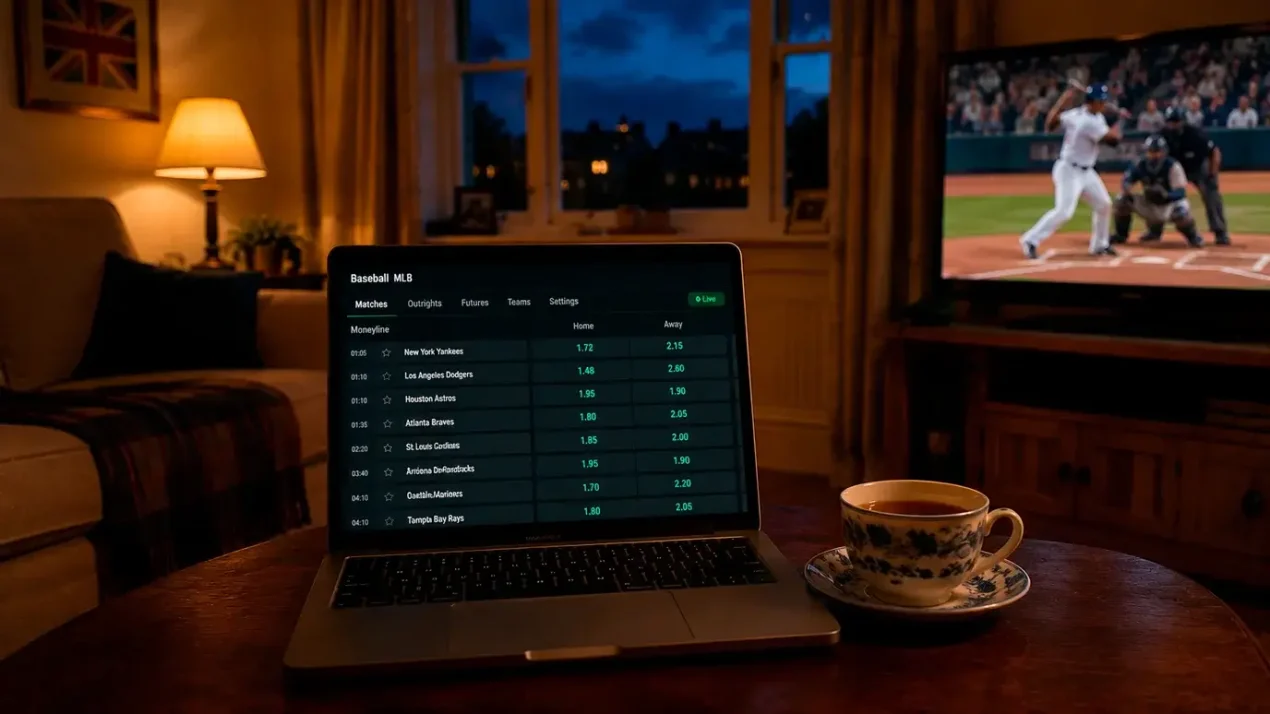
I have been betting on MLB from the UK for six seasons now, and the learning curve was not the sport itself – it was navigating the practical realities that no US-focused guide bothers to explain. Which bookmakers actually offer full MLB slates? How do you handle the time-zone gap when lineups drop at 10pm and games start at midnight? What happens to your accumulator when a game is rained out? These are the questions that matter when you are sitting in London or Manchester trying to find value on a Tuesday night slate in the American League.
This guide covers the regulatory landscape, the available markets, the timing and logistical challenges, bankroll setup in GBP and the odds formats you will encounter. It is the article I wished existed when I first started trying to bet on baseball from this side of the Atlantic.
UKGC Regulated MLB Bookmakers for British Baseball Bettors
The first question anyone asks about betting on MLB from Britain is whether it is legal. The answer is yes, unambiguously – provided you use a bookmaker licensed by the United Kingdom Gambling Commission. The UKGC is one of the most rigorous regulatory bodies in global gambling, and its licensing requirements are the reason UK bettors enjoy a level of consumer protection that their American counterparts in many states still lack.
What does a UKGC licence actually guarantee? Several things that matter directly to your experience as an MLB bettor. First, the bookmaker must segregate customer funds from operating capital, which means your balance is protected even if the company hits financial trouble. Second, the operator must offer responsible gambling tools – deposit limits, loss limits, session time reminders and the option to self-exclude through GamStop. Third, every bet, every market and every payout is subject to regulatory oversight, with the UKGC empowered to audit, fine or revoke licences from operators that violate the rules.
Remote gambling in the UK is a substantial industry in its own right. Remote casino, betting and bingo generated £7.8 billion in gross gambling yield between April 2024 and March 2025, a 13.1% increase year on year. That growth has prompted the UKGC to tighten its oversight further, introducing enhanced affordability checks – where bookmakers must verify that customers can afford their level of gambling – and stricter age-verification protocols. These checks can feel intrusive when you are simply trying to place a £10 moneyline bet on a baseball game, but they exist for a reason: 48% of UK adults participated in some form of gambling in the past four weeks as of late 2025, and the regulator’s job is to ensure that participation remains safe.
The contrast with the US regulatory landscape is stark. American sports betting is regulated state by state, creating a patchwork of rules, tax rates and legal frameworks. A bettor in New York operates under different rules to one in Arizona, and many states still do not allow online sports wagering at all. The UK’s nationwide, single-regulator model is simpler, more transparent and, from the bettor’s perspective, more protective. When you bet through a UKGC-licensed platform, you know exactly what protections apply – and they apply to every market, including MLB.
One practical point: always verify the licence. Every UKGC-licensed bookmaker displays its licence number in the footer of its website. If you cannot find a licence number, do not deposit. The number can be cross-checked on the Gambling Commission’s public register. It takes 30 seconds and eliminates the risk of betting with an unlicensed operator – a risk that is small in the UK but not zero, particularly with offshore platforms that market to British customers without holding the appropriate licence.
The affordability checks deserve a specific mention because they catch many MLB bettors off guard. If your cumulative deposits or net losses cross certain thresholds – which vary by operator but typically start at £100-£250 in monthly net deposits – the bookmaker may pause your account and request financial documentation. This can be a payslip, a bank statement or a tax return. The process exists to ensure you are not gambling beyond your means, and while it can be frustrating when you are simply trying to place a bet on a Tuesday night baseball game, it is non-negotiable under UKGC rules. Factor this into your planning: if your monthly MLB betting volume might trigger an affordability check, have the documentation ready in advance so the pause is as short as possible.
Which MLB Markets Are Available at UK Bookmakers
I learnt quickly that not all UK bookmakers treat MLB equally. Some offer a full 15-game slate with moneyline, run line, totals and selected props. Others list five or six headline games with moneyline only, and if you want anything beyond that, you are out of luck. Knowing which markets are available – and which are conspicuously absent – saves you from building an analysis around a bet you cannot actually place.
Moneyline is universally available. Every UKGC-licensed bookmaker that offers MLB will have the straight-up winner market. The odds quality varies – the spread between the best and worst price on a given moneyline can be 0.10 to 0.15 in decimal terms – but the market exists. Run line (the 1.5-run spread) is offered by most major platforms but not all. The smaller or more football-focused bookmakers sometimes skip it, particularly for early-season and low-profile midweek games.
Totals (over/under on combined runs) are available at most large UK bookmakers, though the range of available lines can be narrow compared to US platforms. Where an American sportsbook might offer totals at 7.5, 8, 8.5 and 9 with different prices, a UK book might list only the primary number at 8.5 with a single over/under price pair. That limits your ability to shop for alternative totals, which is a meaningful constraint if your model projects a number that falls between the available lines.
Props are the thinnest market area. Strikeout totals for starting pitchers are available at the larger UK bookmakers, particularly for the bigger games and nationally televised matchups. Home-run props, hits and total-bases markets appear less consistently. Futures – World Series winner, division winners, MVP and Cy Young – are well-covered at most platforms, though the odds tend to be wider than what you would find at a US book. UK punters place more than 290 million online bets on real sporting events every month, but the fraction of that volume going to MLB futures is tiny, which means the bookmaker has less incentive to sharpen the price.
Accumulators are worth mentioning because they are a staple of UK betting culture and they do apply to MLB. You can combine multiple moneylines, run lines or totals into a single accumulator ticket, with each leg multiplying the odds. The risk, of course, is that one losing leg collapses the entire bet. For MLB specifically, rain-out rules vary by bookmaker: some void the leg and recalculate the accumulator; others settle the entire ticket as a loss. Read the terms before adding a game with a weather risk to your acca.
My recommendation for new MLB bettors in the UK: open accounts with at least three bookmakers that offer full-slate coverage. This gives you the ability to compare prices on every game, access different prop markets and spread your action to avoid account restrictions. Keep a simple comparison sheet – three columns, one per bookmaker, noting the decimal price for each side of your target games. The two minutes this takes before each bet will pay for itself many times over across a six-month season.
Time Zones, Late Lineups and Other Practicalities of Betting MLB From Britain
The time-zone gap is the single biggest practical hurdle for UK-based MLB bettors, and it took me a full season to develop a workflow that handled it without ruining my sleep. The MLB schedule is built around US time zones, and that means the typical evening slate starts at midnight or 1am BST. Matinee games – usually Sunday or the odd Thursday getaway day – begin around 6pm BST, which is manageable. But the bulk of the action happens when most British bettors are either asleep or trying to be.
Lineups are announced approximately two to three hours before first pitch. For a 1:05am BST game (7:05pm Eastern), lineups appear around 10:30-11:00pm BST. That gives you a window to review the confirmed starters and batters before placing your bet – if you are still awake. For matinee games, lineups drop around 3:00-4:00pm BST, which fits neatly into a post-work routine.
My daily rhythm looks like this: I do my initial analysis in the afternoon – scanning the slate, running my models, identifying targets – using projected lineups that are published by beat reporters around midday. When the official lineups confirm at 10-11pm, I cross-check against my projections. If the confirmed lineup matches what I expected, I place the bet immediately. If there is a significant change – a key hitter resting, a bullpen day announced – I re-evaluate. Most nights, the confirmation step takes 10 minutes.
Mobile betting makes this workflow possible. About 76% of UK adults aged 18-24 use their mobile phone for gambling, and that figure likely underestimates the proportion among MLB bettors in Britain because the late-night timing practically demands a mobile-first approach. I place most of my MLB bets from my phone while in bed – not glamorous, but effective. The apps from major UK bookmakers handle MLB markets competently, though the interface is often less polished than their football offering.
One timing trap to avoid: placing bets on early games and late games simultaneously without accounting for lineup overlap. A matinee game at 6pm BST and a night game at 1am BST are seven hours apart. Bullpen usage in the early game can affect the late game if it is between the same teams in a doubleheader or a series. Always check whether your slate contains connected games before locking in bets hours apart.
Setting Up a GBP Bankroll for the MLB Season
Setting up a dedicated GBP bankroll for the MLB season was one of the best process decisions I ever made. Before that, my baseball bets came from the same pot as my football wagers, my tennis punts and the occasional horse-racing flutter. The result was that I never knew whether my MLB strategy was profitable because the numbers were muddled with everything else. Separating the bankroll gave me clarity – and accountability.
Here is a concrete example. A starting bankroll of £500, allocated exclusively to MLB from April to October. At 1-2% unit sizing, each bet is £5 to £10. Over a typical season, I place 250-350 wagers. At a 3% ROI – a realistic target for a disciplined approach – that £500 bankroll generates £37 to £52 in profit across the season on the lower unit size. The numbers are modest in absolute terms, but the point is not to get rich from a £500 bankroll – the point is to prove your process works at a manageable level of risk before scaling up.
Seasonal planning matters because the MLB season is long. From Opening Day in late March through the World Series in October, you are looking at roughly 26 weeks of active wagering. I front-load my unit allocation slightly – 1.5% in April and May when my models are calibrating, 2% from June through August when the data is most reliable, and back to 1.5% in September when roster changes and motivation variables introduce noise. That is not a rigid formula; it is an acknowledgement that your edge is not constant across the season.
Responsible gambling is not a footnote – it is a structural requirement. Dr. Harry Levant of the Public Health Advocacy Institute has been outspoken about the industry’s need for stronger consumer protections, and his concerns apply directly to the individual bettor’s behaviour. Set a deposit limit on your bookmaker account before the season starts. Use the loss-limit tools. If your bankroll drops by 30% from its starting level, stop betting for two weeks and review your process. GamStop self-exclusion is available if you need it, and every UKGC-licensed bookmaker is required to honour it. The goal is sustainable, analytical betting – not a thrill ride that ends in a blown account and regret.
One more structural point: keep your MLB bankroll in a responsible gambling framework from day one. That means tracking every deposit, every withdrawal and every bet in a separate ledger. The transparency is uncomfortable at first – nobody likes watching a cold streak in high definition – but it is the only way to separate good process from bad luck and bad process from good luck.
Reading MLB Odds in Decimal and Fractional Formats
Most UK bookmakers default to decimal odds, which is a relief for MLB bettors because decimal is the cleanest format for quick calculations. A line of 2.30 tells you instantly: for every pound you stake, you get £2.30 back if you win, including your original stake. Profit = stake x (odds – 1). A £10 bet at 2.30 returns £23, with £13 profit. No fractions, no negative signs, no base-unit confusion.
Fractional odds still appear on some traditional UK platforms and in certain media coverage. The conversion is straightforward: decimal = (numerator / denominator) + 1. Fractional 5/4 becomes (5 / 4) + 1 = 2.25 decimal. The problem with fractions for MLB is that the numbers get awkward – a line of 1.67 decimal is 2/3 fractional, which is unintuitive for quick mental maths. If your bookmaker uses fractions by default, switch to decimal in the account settings. Every major UK platform offers the choice.
The conversion you will need most often is from American odds, because the vast majority of MLB analysis, line-movement data and sharp-money tracking comes from US sources. The formulas: for negative American odds, decimal = 1 + (100 / absolute value). For positive American odds, decimal = 1 + (value / 100). So -140 = 1 + (100/140) = 1.714. And +150 = 1 + (150/100) = 2.50. After a few weeks of doing this, the common conversions become second nature – you will see -130 and immediately think 1.77 without reaching for a calculator.
One format-related trap: some US analysts quote odds in American format and reference them as “the price,” assuming their audience is American. When they say “I like this at -120 or better,” they mean the decimal equivalent of 1.83 or higher. “Better” in American negative odds means a smaller negative number (closer to -100), which means a higher decimal price. It is counterintuitive until you have trained yourself to think in both systems simultaneously. I keep a conversion cheat sheet bookmarked on my phone for the first few months until the mental translation became automatic.
The format itself is never the edge – the edge comes from what you do with the numbers once you can read them. But fluency in all three formats (decimal, fractional, American) eliminates a cognitive barrier that slows down your analysis and occasionally causes costly errors. I once missed a value bet because I misread -130 as 1.30 decimal instead of 1.77, and by the time I caught the mistake, the line had moved. That was a lesson I only needed to learn once. Master the conversion, and the rest of your MLB betting process – from implied probability to line-movement tracking to bankroll allocation – flows without friction.
Is it legal to bet on MLB in the United Kingdom?
Yes. Betting on MLB is fully legal in the UK when you use a bookmaker licensed by the United Kingdom Gambling Commission. UKGC-licensed operators are regulated, required to segregate customer funds, and must offer responsible gambling tools including deposit limits, loss limits and GamStop self-exclusion. Always verify the licence number in the bookmaker’s website footer before depositing.
Do UK bookmakers offer MLB prop bets?
Some do, but coverage is inconsistent. The larger UK bookmakers offer strikeout totals for starting pitchers and occasionally home-run and hits props on headline games. Pitch-level props are effectively unavailable following MLB’s $200 cap in November 2025. Futures markets – World Series winner, division winners, MVP – are more widely available. Check multiple platforms to find the best prop coverage for each day’s slate.
What time do MLB games start in UK time zones?
Matinee games typically begin around 6pm BST (1pm Eastern). The main evening slate starts between midnight and 1am BST (7pm-8pm Eastern). Sunday games often have earlier start times, with first pitches from 5pm BST onwards. Lineups are confirmed two to three hours before first pitch, so expect lineup news between 10pm and 11pm BST for the late slate.
This material was created by the bestmlbbetuk.com team.
Related posts

Weather Impact on MLB Betting: Wind, Temperature and Air Pressure Quantified

MLB Betting Mistakes: The Ten Errors That Drain Your Bankroll Fastest