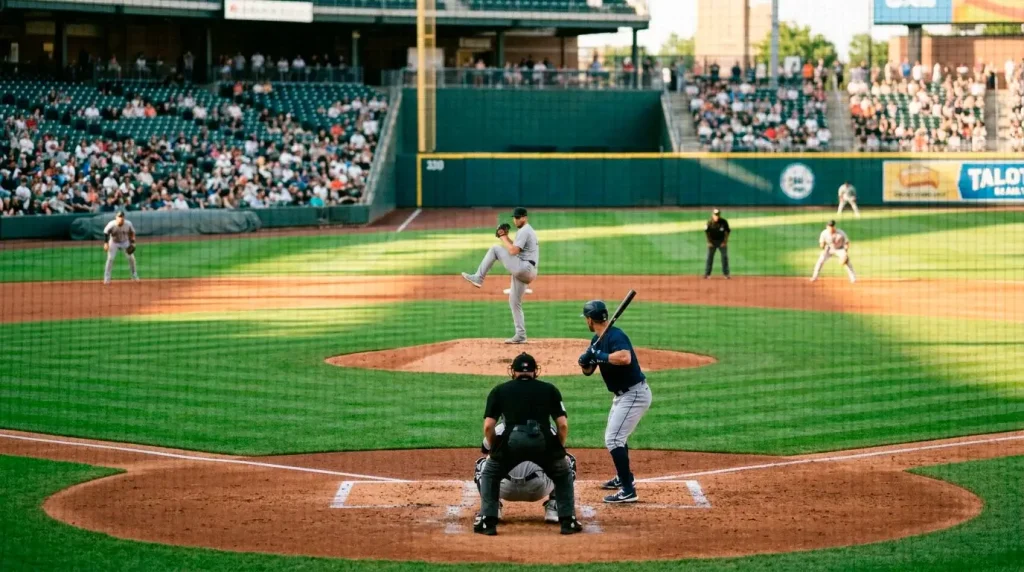
Long-Term MLB Futures and Win Totals
 Available in US
The MLB market was valued at $13.2 billion in 2025 and is projected to reach $21.0 billion by 2033, reflecting a sport whose commercial footprint is expanding. Within that growing market, futures betting represents a small but strategically important slice. Unlike daily moneyline or totals bets that settle within hours, futures tie up your capital for weeks or months. That illiquidity is a cost — but it’s also the reason futures prices are often softer than game-day markets. Bookmakers know that most recreational bettors prefer instant gratification, so the sophisticated money that hunts futures value faces less competition.
Bill Miller, CEO of the American Gaming Association, has pointed to record revenues and tax contributions as evidence of the broad appeal of regulated gaming markets. Futures are a prime example: they engage bettors across the entire season rather than on individual games, creating sustained interest that benefits both the industry and the informed bettor who knows when to buy and when to wait.
Pricing World Series Futures: Value Windows and Hedging Models
There are two optimal windows for World Series futures, and most bettors miss both. The first opens in late February, after pitchers and catchers report but before spring training games begin. At this point, the market is driven by preseason projections, offseason acquisitions and public perception. Teams that made splashy signings get overbet, compressing their odds below true value, while quieter teams that improved through trades or internal development sit at inflated prices. I’ve found some of my best-returning futures bets in that February-to-March window on teams the public hasn’t noticed yet.
The second window opens immediately after the trade deadline in late July. Contending teams that acquired impact players see their odds shorten dramatically within 48 hours — but the market often overreacts. A team that was 14.00 before trading for a top starter might drop to 8.00 overnight, which is too sharp a move based on one acquisition. Meanwhile, teams that were quiet at the deadline but maintain a strong roster and a favourable September schedule sometimes drift to longer odds, creating value for the patient bettor.
Hedging is the escape valve for futures. If you took a team at 22.00 and they reach the World Series, you can bet the opponent on the Series moneyline to lock in a guaranteed profit regardless of the outcome. The hedging calculation is simple: determine the payout if your futures bet wins, then wager enough on the other side to equalise your returns. I hedge selectively — only when the guaranteed profit from hedging exceeds what I’d want to risk on the original position. If I’m confident in the original pick, I let it ride and accept the variance.
Season Win Totals: Why the Preseason Is the Best Time to Bet Over or Under
Win totals are my favourite MLB futures market, and the reasoning is data-driven. Bookmakers set each team’s projected wins total in early March based on roster analysis, projection systems and public betting patterns. The number typically lands within 2 to 3 wins of the consensus projection, and the juice is set at -110 on each side (roughly 1.91 in decimal).
The value in win totals comes from identifying projection errors before the season proves them wrong. In a league of 2,430 total games, the difference between a 78-win team and an 86-win team often comes down to three or four factors: starting rotation health, bullpen depth, a breakout hitter, or a favourable schedule. If your preseason analysis identifies one of these factors that the projection systems underweight, you can bet the over or under at prices that won’t be available once the season validates or invalidates the thesis.
I focus on two specific angles. The first is rotation depth beyond the top two starters. Projection systems weight aces heavily but often undervalue the fourth and fifth starters, who make 60+ combined starts per season. A team with a quietly improved back-end rotation will outperform its win total more often than one that added a single star but left the rest of the staff unchanged. The second angle is schedule asymmetry. Some teams face a disproportionate number of games against rebuilding opponents in the same division, which inflates their win total beyond what their roster would produce in a balanced schedule.
Divisional Winners and MVP Markets: Smaller Pools, Bigger Edges
World Series futures and win totals get the most attention, but the division-winner and MVP markets are where I’ve found the most consistent value. The reason is pool size. A World Series bet requires your team to survive the playoffs — a crapshoot of short series. A division-winner bet only requires them to finish first in a five-team division over 162 games, which is a much better test of season-long quality.
Division-winner odds are typically longer than you’d expect because the parlay-minded public gravitates toward the World Series market for the bigger payout. This leaves division-winner prices slightly inflated, especially for teams in weaker divisions where one or two strong rosters face three rebuilding opponents. I’ve backed division winners at 3.50 to 5.00 in decimal odds and cashed at a higher rate than my World Series bets, even though the per-bet payout is lower.
MVP markets are smaller pools still — typically 10 to 15 serious contenders in each league. The key insight is that MVP voting is driven by narrative as much as statistics. A player on a playoff team with a compelling story (bounce-back season, first-time contender, milestone chase) gets more votes than a statistically superior player on a losing team. By identifying which players are positioned for both the statistical output and the narrative arc, you can find MVP futures at prices that don’t reflect the true probability. My process: shortlist five players in each league based on projected WAR, then eliminate anyone whose team is projected to miss the playoffs. The remaining three or four names are the pool I’m betting from, usually in that February window when the odds are widest.
When is the best time to place MLB futures bets?
The two best windows are late February to early March, when preseason odds are widest and public perception hasn’t been shaped by results, and immediately after the trade deadline in late July, when market overreactions to deadline acquisitions create mispriced odds on both buyers and quiet contenders. Avoid placing futures mid-season without a specific catalyst, as the prices have already incorporated months of results.
Can you hedge an MLB futures bet mid-season?
Yes. If your futures selection reaches the postseason or the World Series, you can bet the opposing side on individual series or games to lock in a guaranteed profit. The hedge amount depends on the payout from your original futures bet and the current odds on the opponent. Hedging is most effective when your futures bet has appreciated significantly in value and you want to secure profit without relying on the final outcome.
This material was created by the bestmlbbetuk.com team.
Related posts

Weather Impact on MLB Betting: Wind, Temperature and Air Pressure Quantified

MLB Betting Mistakes: The Ten Errors That Drain Your Bankroll Fastest